
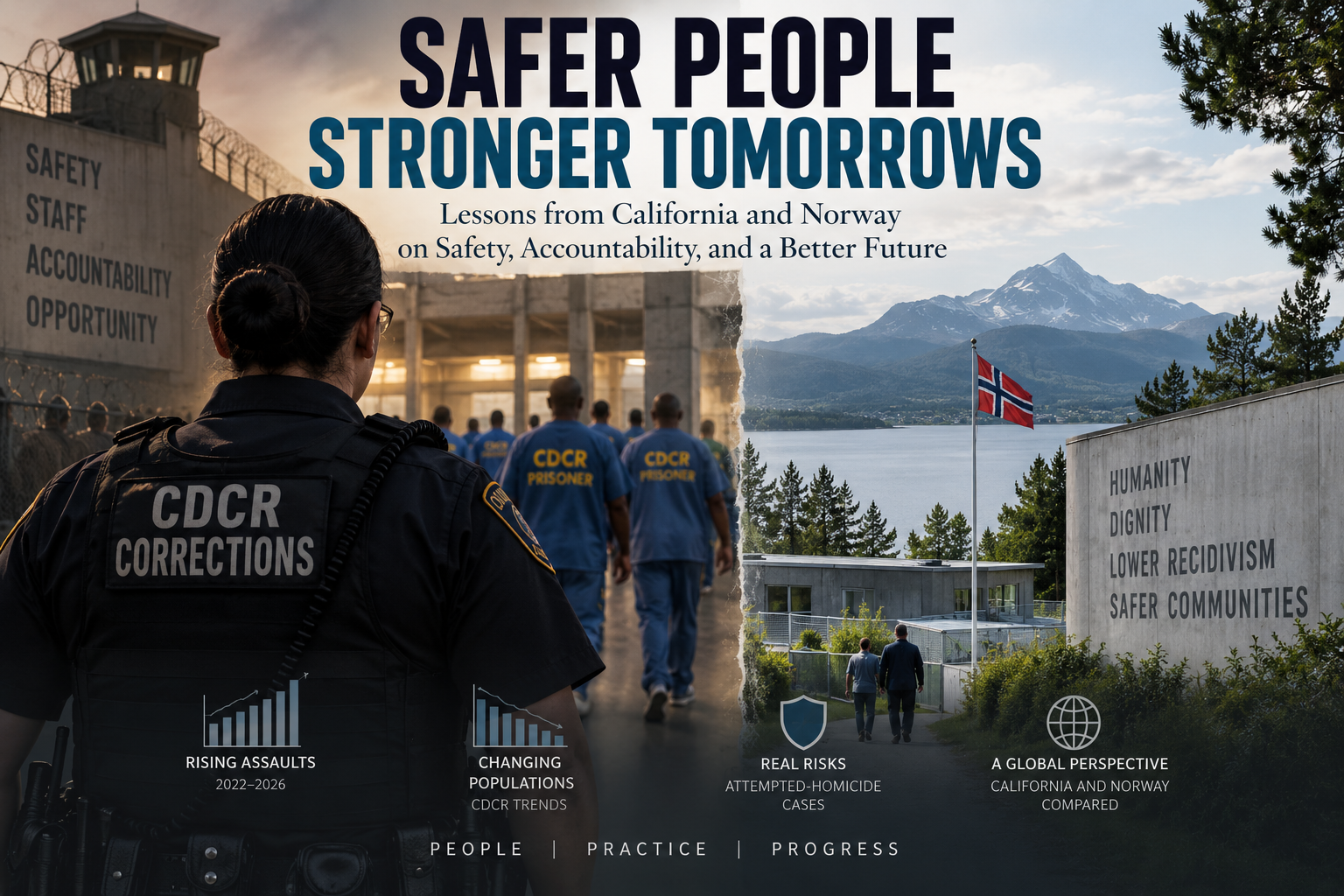
Violence, Reform and the Changing Reality Inside California’s Prisons
By: R. P.
Abstract
The California Department of Corrections and Rehabilitation is undergoing one of the most ambitious transformations in American corrections. Through the California Model, the department has emphasized rehabilitation, normalization, dynamic security, peer mentorship and trauma-informed practices while California’s incarcerated population continues to decline.
At the same time, violence against correctional employees has emerged as a serious operational concern.
Data compiled by The Toughest Beat from CDCR incident reporting indicates that monthly attacks on staff have increased substantially since the period immediately preceding implementation of the California Model. Official CDCR actions also demonstrate the seriousness of the current environment: in 2025 the department imposed modified programming across numerous higher-security institutions in response to rising violence, and in 2026 CDCR itself proposed tightening restricted-housing regulations after acknowledging a significant surge in violent incidents, including assaults on staff.
The central question facing California corrections is therefore not whether rehabilitation should continue. It is whether California can pursue rehabilitation while simultaneously preserving the security, accountability, staffing and tactical practices necessary to protect the employees responsible for making rehabilitation possible.
A Correctional System in Transition
California’s prison system looks dramatically different today than it did a decade ago.
Its institutional population has fallen substantially, facilities have closed or been deactivated, sentencing and credit policies have changed, rehabilitation has assumed a larger role in correctional policy, and CDCR has embarked upon what it calls a “once-in-a-generation transformation” through the California Model.
CDCR describes the model as an effort to improve both institutional culture and public safety through four principal concepts: dynamic security, normalization, peer mentorship and becoming a trauma-informed organization. The department says these concepts are intended not merely to improve conditions for incarcerated people but also to improve the working environment and wellness of employees.
Those are legitimate objectives.
The problem is that another trend has developed during this transformation: employees continue to experience hundreds of attacks by incarcerated people in individual months.
According to analysis published by The Toughest Beat, CDCR averaged approximately 243 staff attacks per month from January 2022 through the beginning of the California Model period in March 2023. The publication calculated the subsequent average at approximately 359 attacks per month, representing a substantial increase.
The increase has occurred while the prison population has moved in the opposite direction.
CDCR’s official population projections show that the institutional population fell from 97,179 on June 30, 2022, to 96,033 in 2023, 92,582 in 2024 and 90,584 in 2025. The department projected approximately 87,487 incarcerated people for June 30, 2026.
That divergence deserves attention from correctional administrators, policymakers, researchers and labor representatives alike.
A smaller correctional system is not necessarily a safer correctional system.
CDCR Institutional Population, 2022–2026
June 30 actual population, except 2026, which is CDCR’s Fall 2025 projection
2022 — 97,179
2023 — 96,033
2024 — 92,582
2025 — 90,584
2026 — 87,487 projected
The trajectory represents an approximately 10-percent reduction between 2022 and the 2026 projection. CDCR reported separately that on June 3, 2026, the adult institutional population stood at 119.2 percent of institutional design capacity.
Violence Moving Against the Population Trend
One of the clearest snapshots comes from a year-over-year comparison reported by The Toughest Beat.
In September 2023, CDCR housed approximately 95,147 incarcerated people and recorded a combined 251 attacks on staff. By August 2024, the population had fallen to approximately 91,991, but combined attacks on employees had increased to 361.
The pattern continued.
In April 2025, The Toughest Beat reported 387 separate incidents involving attacks on staff, including 307 batteries and four attempted murders of officers.
Then came August.
The publication’s contemporaneous September 29 report identified 459 staff attacks in August 2025, which it described as the highest monthly number it had recorded since beginning its tracking in July 2022.
November 2025 produced 327 reported attacks, including 37 incidents of “gassing,” according to the publication. December increased again to 392. January 2026 recorded 402 attacks, followed by 390 in February.
These figures should be interpreted carefully. The Toughest Beat is a correctional-focused publication and frequently takes an explicitly critical position toward CDCR leadership and the California Model. Its conclusions regarding causation should therefore be distinguished from the underlying incident figures it reports as derived from CDCR data.
But the broader concern cannot simply be dismissed as commentary.
CDCR’s own actions demonstrate that institutional violence has required extraordinary responses.
Selected Staff-Attack Indicators, 2022–2026
Because a complete audited annual series for every year is not presented in the cited public sources, this figure uses clearly identified averages and monthly observations rather than creating artificial annual totals.
Jan. 2022–Mar. 2023: ~243 attacks per month, average
Sept. 2023: 251 attacks
Aug. 2024: 361 attacks
Apr. 2025: 387 attacks
Aug. 2025: 459 attacks
Nov. 2025: 327 attacks
Dec. 2025: 392 attacks
Jan. 2026: 402 attacks
Feb. 2026: 390 attacks
CDCR’s Own Response to Rising Violence
The most compelling evidence that the safety problem deserves serious attention does not come from criticism of CDCR.
It comes from CDCR itself.
On June 12, 2025, CDCR placed men’s Level III and Level IV facilities throughout the state on modified programming because of what the department called a “recent and concerning rise in violent incidents directed towards both staff and incarcerated individuals.”
The action affected more than 20 institutions or facilities.
Movement was restricted, visitation was suspended and programming was modified while the department investigated the violence.
Five days later, CDCR released additional information.
Between May 29 and June 12, affected institutions recorded 42 assaults on staff, 171 batteries on staff and three attempted homicides targeting peace officers. Searches recovered 53 improvised weapons, 66 cellular phones, 24 syringes and 155 other contraband items.
That response demonstrates something important.
Whatever disagreement exists over the causes of rising violence, the underlying security problem is real enough that CDCR itself has restricted institutional movement and conducted major security operations in response.
Even more significant evidence appeared in 2026.
In a May 2026 regulatory notice addressing Restricted Housing Unit regulations, CDCR stated that after adoption of less restrictive regulations, the department had experienced a significant surge in violent incidents and overdoses, including murder, assaults on staff and assaults among incarcerated people.
CDCR proposed restoring stronger disciplinary consequences and explicitly said the changes were intended to reinforce institutional safety and staff security.
That acknowledgment should be central to any serious discussion about staff safety.
Attempted Homicide: When Statistics Become People
Monthly assault totals describe frequency.
Attempted homicide investigations demonstrate severity.
On March 9, 2026, an inmate at California State Prison, Sacramento attacked a correctional officer inside a cell block. According to CDCR, the officer sustained multiple puncture wounds before responding employees stopped the attack. An improvised weapon was recovered. The officer required outside medical treatment, and CDCR investigated the incident as an attempted homicide.
Five months later, another serious attack occurred at Kern Valley State Prison.
On August 6, an inmate ignored staff orders while possessing an improvised weapon, ran toward custody employees and struck an officer in the protective vest. The attacker then allegedly pushed the officer to the ground, escaped the immediate confrontation and attacked another incarcerated person before staff ultimately subdued him. Two custody officers required outside medical treatment. CDCR again opened an attempted-homicide investigation.
Then, on August 28, violence reached beyond custody staff.
At Salinas Valley State Prison, an inmate struck a health-care employee from behind. Staff initiated lifesaving measures, the employee was transported to an outside hospital and an improvised weapon was recovered. CDCR announced that the incident was being investigated as attempted murder.
Less than two weeks later, another correctional officer was attacked.
On September 9, 2026, at Richard J. Donovan Correctional Facility, staff observed an inmate attack an officer on a yard. Employees used chemical agents and physical force to stop the assault. The officer required outside medical treatment, and staff recovered an improvised weapon. CDCR classified the investigation as an attempted homicide.
These cases occurred at different institutions and under different circumstances. They should not be treated as evidence that every institution or every inmate presents the same risk.
But collectively they demonstrate the potential consequences of correctional violence.
For the employee working a housing unit, medical clinic, yard or control position, “staff safety” is not an abstract policy category.
It can become a matter of survival in seconds.
The California Model: Ambition Meets Operational Reality
Governor Gavin Newsom announced the state’s commitment to the California Model in March 2023.
CDCR subsequently identified initial test sites and expanded implementation. Department materials describe Resource Teams trained in dynamic-security principles operating even at higher security levels with the objective of reducing violence, use-of-force incidents and harms associated with isolation.
CDCR’s theory is straightforward.
Traditional correctional security relies heavily upon physical barriers, procedures, observation and enforcement. Dynamic security supplements those measures by encouraging staff to know the incarcerated population, communicate professionally and recognize behavioral changes before they become incidents.
CDCR argues that these relationships can reduce violence and employee injuries.
There is nothing inherently incompatible between that concept and officer safety.
Experienced correctional professionals have always understood the value of communication. Knowing the population, recognizing unusual behavior, obtaining intelligence and resolving conflict verbally are fundamental correctional skills.
The dispute is therefore not necessarily over whether employees should communicate effectively with incarcerated people.
The harder question is whether California has imported selected principles from another correctional system without importing enough of the structure that makes those principles work.
That brings the discussion to Norway.
California Is Not Norway
Norway is frequently invoked in discussions of the California Model, but comparisons between the two systems require considerably more nuance than pictures of Norwegian prison cells or discussions of normalization.
The Norwegian Correctional Service describes the principle of normality as the proposition that imprisonment itself is the punishment. Individuals retain other rights unless restrictions are necessary for security.
But Norway’s own description contains a qualification sometimes overlooked in American discussions: normalization remains constrained by security considerations, correctional management, differences among prisons, personnel, infrastructure and financial resources.
In other words, normalization does not mean the abandonment of security.
More importantly, Norway developed an entire correctional structure around its philosophy.
Norwegian correctional officers undergo approximately two years of education at the Staff Academy. Their curriculum includes psychology, criminology, law, human rights and ethics. They receive pay while completing that education.
CDCR itself highlighted the contrast after California officials visited Norway in 2019: Norwegian officers received two years of training compared with what CDCR at the time described as a 13-week Basic Correctional Officer Academy.
That difference is not trivial.
Dynamic security asks more of an officer than simply being friendly.
It asks the officer to observe behavior, develop professional relationships, identify changes in risk, communicate effectively, understand human behavior, exercise judgment and simultaneously maintain authority and boundaries.
If California wants Norwegian-style correctional relationships, the Norwegian investment in the people responsible for creating those relationships deserves equal attention.
Different Populations, Different Sentences, Different Systems
There are other fundamental differences.
Norway reports a correctional capacity of just over 3,600 cells across its prison units. Its average prison sentence is approximately eight months, more than 60 percent of unconditional prison sentences are three months or less, and nearly 90 percent are less than one year.
California’s correctional environment is dramatically different.
CDCR manages tens of thousands of inmates, including large populations serving lengthy determinate sentences, life sentences and life without parole.
Norway also uses a progression model in which incarcerated individuals generally move toward lower-security environments and eventual community reintegration based on individual risk, needs and resources.
These structural differences do not mean California has nothing to learn from Norway.
They mean California cannot simply import the visible features of Norwegian corrections while ignoring the conditions underneath them.
California officials themselves recognized this problem years before statewide implementation.
After a 2019 visit, then-CDCR Secretary Ralph Diaz emphasized that California could not simply transplant the Norwegian system into a vastly different correctional population. The objective, he explained, was to take useful concepts and develop a distinctly California approach.
That remains sound advice.
Dynamic Security Requires Static Security
One of the false choices in contemporary correctional discussions is the assumption that relationship-based correctional practices must replace traditional security.
They should not.
Static, organizational and dynamic security perform different functions.
Walls, fences, controlled doors, searches, restraints, protective equipment and secure movement constitute parts of static security.
Policies, classification systems, disciplinary procedures, intelligence operations and emergency-response protocols contribute organizational security.
Communication, professional relationships and knowledge of individual behavior contribute dynamic security.
A safe correctional system needs all three.
A correctional officer who knows the population may recognize that an inmate is behaving unusually.
That is dynamic security.
An officer who maintains proper positioning and reactionary distance is practicing personal security.
A functioning alarm system and controlled door provide static security.
A trained response team and clearly established procedure provide organizational security.
None makes the others obsolete.
California’s challenge is therefore to ensure that implementation of dynamic security does not inadvertently communicate that traditional officer-safety practices are incompatible with rehabilitation.
Respect and vigilance can coexist.
So can empathy and authority.
Accountability Is Part of Rehabilitation
Perhaps the most important lesson emerging from California’s current experience is that rehabilitation cannot exist without accountability.
In May 2026, CDCR’s own proposed regulatory changes implicitly recognized this principle.
The department proposed reinstating stricter consequences for misconduct following what it characterized as unintended consequences associated with less restrictive Restricted Housing Unit regulations. Among the proposed changes were stronger restrictions for specified privilege groups, limitations on tablet communications following misconduct and changes allowing consecutive or concurrent RHU terms under specified circumstances.
This should not be interpreted as abandonment of rehabilitation.
It can instead be understood as recalibration.
A rehabilitative correctional system must reward constructive behavior while establishing meaningful consequences for predatory and violent behavior.
Privileges should have value.
Progression should have meaning.
Violence should interfere with progression.
That principle is consistent with rehabilitation because learning to connect behavior with consequences is itself part of successful reintegration.
A Smaller Population Can Be a More Difficult Population
CDCR’s declining population creates another policy challenge.
It is tempting for policymakers to assume that fewer incarcerated people should automatically mean proportionally fewer employees, lower correctional budgets and less institutional risk.
Corrections does not operate that neatly.
The Toughest Beat argues that population reduction can leave institutions supervising a population increasingly concentrated with higher-risk individuals, complex behavioral needs, serious mental-health needs and resistance to institutional authority.
That argument deserves empirical study rather than automatic acceptance, but the underlying principle is plausible: head count alone is an incomplete measure of workload or risk.
One hundred relatively stable minimum-security individuals do not necessarily require the same resources as 100 maximum-security individuals with histories of violence, mental-health crises, gang involvement or repeated institutional misconduct.
Correctional staffing should therefore be based on more than population totals.
Risk, institutional mission, housing configuration, medical and mental-health acuity, programming requirements, transportation demands, contraband activity and emergency-response capability all matter.
Staffing Is a Safety System
Every correctional officer understands the significance of response time.
When an alarm activates, the difference between immediate assistance and delayed assistance can determine whether an employee receives minor injuries, serious injuries or worse.
Staffing is therefore not merely a labor issue.
It is part of the institution’s security architecture.
Adequate staffing allows institutions to conduct searches, supervise movement, maintain observation, respond to emergencies and provide programming without compromising basic security posts.
Insufficient staffing can create cascading effects.
Posts may be consolidated. Overtime increases. Employees become fatigued. Training opportunities may become more difficult to schedule. Supervisors spend more time filling immediate vacancies and less time mentoring employees or evaluating operations.
The effects eventually reach rehabilitation as well.
Programming requires security.
Education requires movement.
Medical appointments require escorts.
Reentry services require controlled access.
A correctional system cannot sustainably increase programming while simultaneously weakening the staffing structure that allows programming to occur safely.
Staff Wellness Cannot Be Separated from Staff Safety
CDCR frequently emphasizes employee wellness as part of the California Model.
That is appropriate.
But wellness cannot be addressed exclusively through resilience programs, peer support or post-incident services.
Those resources are valuable, particularly following traumatic events. CDCR specifically reported offering peer-support and other services following several of the attempted homicide incidents discussed earlier.
Yet the first component of employee wellness must be reducing preventable exposure to trauma.
Correctional employees routinely encounter violence, suicide attempts, self-harm, medical emergencies, threats, weapons, bodily fluids and human suffering.
Repeated exposure accumulates.
An organization concerned about wellness should therefore ask not only, “How do we help employees after traumatic events?”
It should also ask, “Which traumatic events can we prevent?”
Those are complementary responsibilities.
Two Trends Moving in Opposite Directions
Institutional population
97,179 — June 2022
96,033 — June 2023
92,582 — June 2024
90,584 — June 2025
87,487 — June 2026 projection
Staff violence indicators
~243/month — Jan. 2022–Mar. 2023 average reported by The Toughest Beat
251 — September 2023
361 — August 2024
459 — August 2025
402 — January 2026
390 — February 2026
The datasets are not identical annual measures and should not be presented as proof of causation. What they illustrate is the central question requiring further analysis: Why has the institutional population declined while reported attacks on employees remained elevated or increased?
Correlation Is Not Causation
Any credible evaluation of the California Model must acknowledge a critical limitation.
The rise in staff violence occurred during implementation of the California Model.
That does not, by itself, prove that the California Model caused the rise.
Institutional violence is affected by numerous variables:
population composition, classification, mental illness, gang activity, drug availability, contraband, staffing, disciplinary policy, housing practices, prison closures, sentence structure and institutional culture, among others.
The Toughest Beat argues forcefully that the California Model contributed to declining staff safety.
CDCR argues in the opposite direction: that dynamic security, respectful relationships and normalization should reduce incidents and improve employee wellness.
Those competing claims create an opportunity for serious research.
Instead of asking which narrative sounds better, California should test them.
What CDCR Should Measure
A meaningful evaluation should compare institutions, security levels and time periods while controlling for changes in population.
The analysis should include assaults and batteries against employees, gassings, attempted homicides, staff injuries, weapons recoveries, uses of force, inmate-on-inmate violence, homicides, suicides, overdoses, workers’ compensation claims, sick leave, vacancies, overtime and employee retention.
California Model institutions should be compared with appropriate control periods and comparable institutions.
Employee perception should also be measured.
Do correctional officers feel safer?
Do sergeants and lieutenants believe they have adequate tools to maintain order?
Do noncustodial employees feel protected?
Do staff believe misconduct receives predictable consequences?
Do employees believe dynamic security improves intelligence and communication?
Those questions can be studied.
If particular California Model practices reduce violence, they should be expanded.
If others correlate with increased violence or weakened institutional control, they should be modified.
The objective should not be to prove that the California Model works.
Nor should it prove that it fails.
The objective should be to discover what works.
The Front Line Must Have a Voice
Correctional reform is often designed far from the housing units where its consequences are experienced.
That is a mistake.
Officers, sergeants, lieutenants, counselors, clinicians, nurses, teachers and other institutional employees possess information that cannot be replicated by spreadsheets alone.
They know which movement procedures create blind spots.
They know where contraband moves.
They recognize which privileges produce leverage and which produce unintended consequences.
They see when disciplinary systems deter misconduct—and when incarcerated people no longer perceive consequences as meaningful.
Frontline experience is not a substitute for research.
But neither should research be separated from frontline experience.
The strongest correctional policy combines empirical evidence with operational knowledge.
Reframing the Debate
The debate over California corrections is too frequently framed as a choice between two extremes.
One side is portrayed as favoring punishment, security and control.
The other is portrayed as favoring rehabilitation, dignity and normalization.
That division is unnecessary.
A secure prison can be rehabilitative.
A humane prison can maintain discipline.
An officer can communicate respectfully while remaining tactically prepared.
An incarcerated person can be treated with dignity while being held accountable for misconduct.
Indeed, effective rehabilitation may depend upon those combinations.
The Norwegian model itself does not eliminate security. Norway explicitly states that normalization is constrained when security requires it.
California should adopt the same clarity.
A Better California Model
The California Model does not necessarily need to be abandoned.
It needs to be evaluated and, where necessary, corrected.
California should retain programs that demonstrably improve behavior, rehabilitation, employee wellness and reentry outcomes.
It should expand high-quality education, vocational training, substance-use treatment and evidence-based programming.
It should encourage professional communication between employees and incarcerated people.
But it should simultaneously strengthen the foundations that allow those programs to operate.
That means adequate staffing.
It means meaningful disciplinary consequences for violence.
It means strong contraband interdiction.
It means tactical training.
It means reliable protective equipment.
It means classification systems that recognize behavioral risk.
It means listening to frontline employees.
And it means acknowledging that a policy producing unintended consequences must be changed rather than defended simply because significant political capital has already been invested in it.
CDCR’s 2026 decision to reconsider aspects of its restricted-housing regulations demonstrates that recalibration is possible.
The same willingness should apply throughout the California Model.
Conclusion: Safety Is the Foundation of Rehabilitation
California is attempting something important.
The state is asking whether its correctional system can do more than incapacitate offenders. It is attempting to prepare people for release, reduce future victimization and create a correctional culture that is more professional and humane.
Those objectives deserve serious consideration.
But California cannot measure success solely through programs offered, privileges expanded, institutional populations reduced or philosophical changes announced.
It must also measure what happens to the people who work inside its prisons.
The numbers compiled by The Toughest Beat raise difficult questions. The publication reports an increase from approximately 243 staff attacks per month during its pre-California Model comparison period to roughly 359 afterward. Individual months have reached 390, 402 and, in August 2025, 459 reported incidents.
Official CDCR actions reinforce the seriousness of the issue.
The department imposed modified programming across higher-security facilities in 2025 because of rising violence.
It recovered dozens of weapons during subsequent security operations.
In 2026, CDCR itself acknowledged a significant surge in violent incidents while proposing stronger restricted-housing consequences.
And correctional employees have continued to become victims of attacks, serious enough to be investigated as attempted homicides.
Those facts do not prove that rehabilitation has failed.
They demonstrate that staff safety must become one of the primary measures by which correctional reform is judged.
California does not need to choose between rehabilitation and security.
It needs both.
Dynamic security should complement static and organizational security.
Normalization should exist within appropriate security boundaries.
Rehabilitation should coexist with accountability.
Employee wellness should begin with preventing avoidable injuries.
And the experiences of the men and women who operate California’s prisons should be considered essential evidence when evaluating correctional policy.
Norway’s system was not created by simply making prisons more comfortable. It was built around a different sentencing structure, a small correctional population, extensive officer education, individualized progression and a philosophy that explicitly recognizes security limitations.
If California intends to learn from Norway, it should learn the entire lesson.
Invest in officers.
Train them extensively.
Give them the resources necessary to develop professional relationships without sacrificing tactical awareness.
Maintain meaningful accountability.
Measure outcomes honestly.
And change policies when evidence shows they are not working.
Ultimately, the success of the California Model will not be determined by what it is called or what policymakers intended.
It will be determined by results.
A correctional system that successfully rehabilitates people while protecting employees can become a model for the nation.
But no correctional philosophy can be considered fully successful if the people responsible for implementing it are increasingly becoming victims themselves.
Rehabilitation requires order.
Order requires professional correctional employees.
And those employees deserve a correctional system designed to give them the best possible chance of going home safely at the end of every shift.
References
California Department of Corrections and Rehabilitation. (2019). California leaders learn from Norwegian prison system. CDCR Inside CDCR.
California Department of Corrections and Rehabilitation. (2024). California Model Magazine.
California Department of Corrections and Rehabilitation. The California Model — Transforming Public Safety.
California Department of Corrections and Rehabilitation. (2024). California Model pillar: Dynamic Security.
California Department of Corrections and Rehabilitation. (2025). CDCR facilities placed on modified program.
California Department of Corrections and Rehabilitation. (2025). Proactive public safety sweep leads to discovery of weapons, other contraband.
California Department of Corrections and Rehabilitation. (2026). Fall 2025 Population Projections. Office of Research.
California Department of Corrections and Rehabilitation. (2026). Notice of Change to Regulations No. 26-04: Restricted Housing Units.
California Department of Corrections and Rehabilitation. (2026). Attempted homicide of California State Prison, Sacramento peace officer under investigation.
California Department of Corrections and Rehabilitation. (2026). Attempted homicide of corrections officer at Kern Valley State Prison under investigation.
California Department of Corrections and Rehabilitation. (2026). Attempted homicide of staff member at Salinas Valley State Prison under investigation.
California Department of Corrections and Rehabilitation. (2026). Attempted homicide of correctional officer at Richard J. Donovan Correctional Facility under investigation.
Norwegian Correctional Service. About the Norwegian Correctional Service.
The Toughest Beat. (2024). New data from CDCR shows attacks on staff continue to rise.
The Toughest Beat. (2025). Increase of inmate attacks on CDCR staff.
The Toughest Beat. (2025). Staff attacks by CDCR inmates reach record numbers.
The Toughest Beat. (2025). How is the California Model impacting CDCR officer safety?
The Toughest Beat. (2025). November 2025 update on CDCR inmate violence against staff.
The Toughest Beat. (2026). CDCR inmate attacks on staff, December 2025 update.
The Toughest Beat. (2026). CDCR inmate violence against staff — February 2026 update.
The Toughest Beat. (2026). California at a crossroads — Why sustained CDCR funding is critical to staff safety.
 Rev Red