
By: R.P.
A Historic Decision With Consequences for Victims’ Families
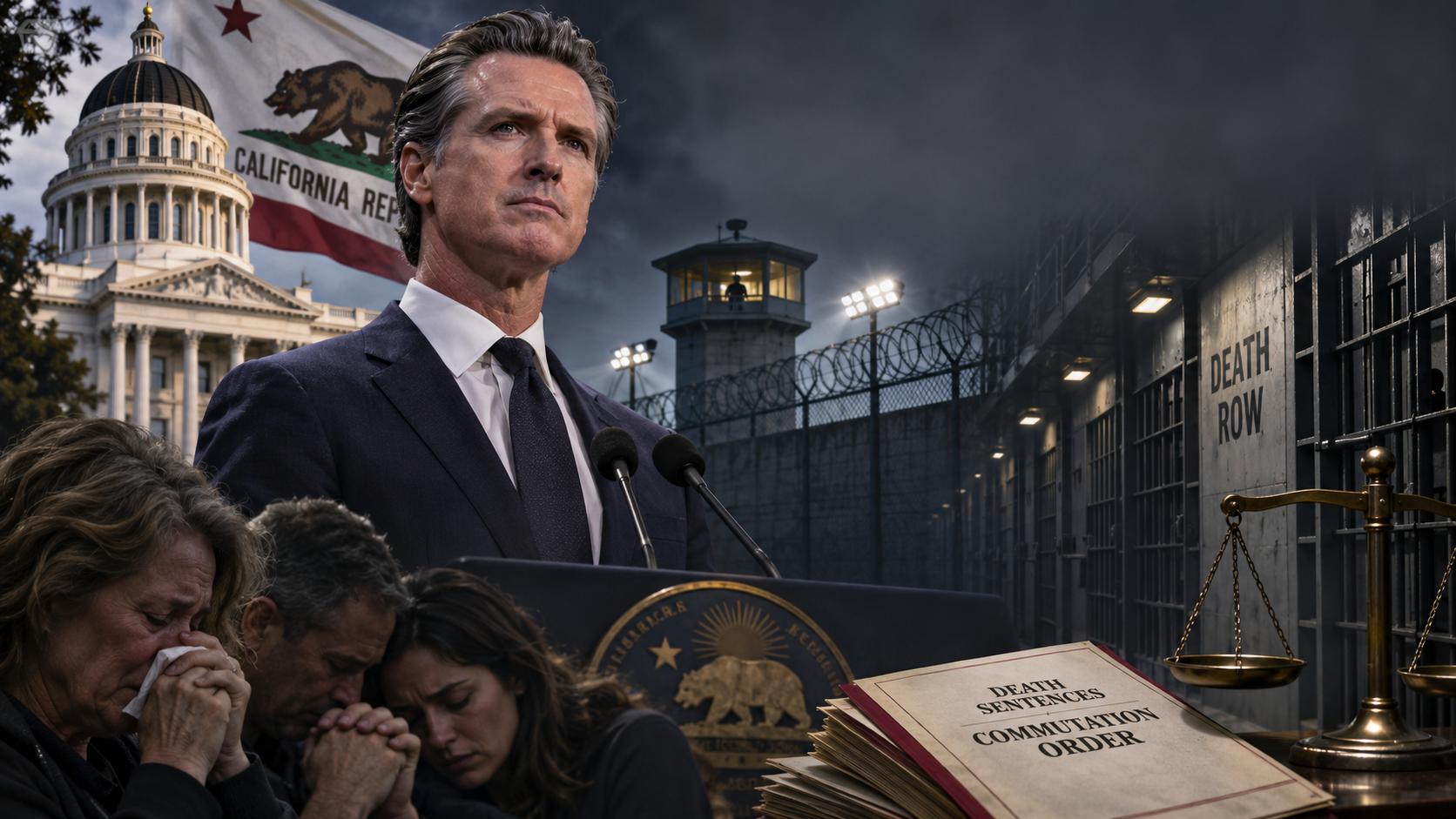
On November 5, 2026, California Governor Gavin Newsom announced one of the most sweeping exercises of executive clemency in American history: his intention to commute the death sentences of all 548 condemned prisoners in California to life imprisonment without the possibility of parole (LWOP).
The decision follows Newsom’s March 2019 moratorium on executions, which prevented California from carrying out death sentences despite capital punishment remaining legal under state law.
For death penalty opponents, the announcement represents the culmination of a decades-long campaign against a punishment they consider unjust, discriminatory, and vulnerable to irreversible mistakes.
For many crime victims and their surviving families, however, the decision represents something fundamentally different: the elimination of a court-imposed punishment after years, sometimes decades, of criminal proceedings, appeals, and assurances that the state’s justice system would honor its judgments.
The controversy extends beyond whether California should retain capital punishment. It raises questions about the relationship between elected officials and voters, the finality of criminal sentences, and the extent to which future changes in sentencing law could affect offenders currently serving life without parole.
One fact must be established at the outset: Newsom’s commutations do not presently authorize the release of these prisoners. His action replaces death sentences with LWOP. However, California already has legal mechanisms through which some prisoners originally sentenced to LWOP can eventually receive parole consideration or other sentence relief.
Understanding the differences between those mechanisms is essential to evaluating the public-safety implications of this decision.
California Voters Repeatedly Supported Retaining the Death Penalty
The political controversy surrounding Newsom’s announcement cannot be separated from California’s electoral history.
California voters reaffirmed their support for capital punishment in multiple statewide elections.
In 2012, voters rejected Proposition 34, which would have repealed the state’s death penalty and replaced death sentences with life imprisonment without parole.
Four years later, the issue returned to the ballot.
In November 2016, California voters considered two competing measures:
- Proposition 62: Would have eliminated the death penalty and replaced existing death sentences with life without parole. Voters rejected the measure, with approximately 53.1% voting against it.
- Proposition 66: Sought to reform and expedite the death penalty process. Voters approved it with approximately 51.1% support.
These elections established that, at those times, a majority of participating California voters preferred retaining the death penalty rather than abolishing it.
The significance of the 2016 election is particularly relevant because Proposition 62 proposed substantially the same sentencing outcome Newsom is now pursuing for existing condemned prisoners: replacing death sentences with LWOP.
Voters rejected that proposal.
Critics therefore argue that Newsom’s decision circumvents the electorate’s expressed preference and achieves through executive clemency an outcome voters declined to adopt through legislation at the ballot box.
There is, however, an important legal distinction between the two actions. Proposition 62 would have changed California’s death penalty law generally. Newsom’s clemency action changes the sentences of specific existing prisoners without repealing the law or prohibiting future death sentences.
Under Article V, Section 8 of the California Constitution, governors possess substantial clemency authority. The fact that voters supported capital punishment does not, by itself, establish that a governor’s commutation is unconstitutional.
Nevertheless, the central accountability question remains: When voters repeatedly support retaining a punishment, how should a governor balance that public decision against his own opposition to carrying it out?
That question deserves serious consideration, regardless of one’s position on capital punishment.
Court-Imposed Death Sentences and Executive Clemency
California’s condemned prisoners received death sentences through criminal proceedings involving juries, judges, and statutory sentencing requirements.
The sentences were not imposed administratively by CDCR. They resulted from judicial proceedings in which prosecutors established the legal grounds for capital punishment.
Many such cases involved extensive appellate litigation and subsequent review.
Newsom’s 2019 moratorium prevented executions from proceeding during his administration. California had already gone without an execution since January 17, 2006, but the moratorium formalized his refusal to authorize them.
The November 2026 decision goes further by seeking to permanently remove the death sentences of the current condemned population.
For 382 prisoners convicted of more than one felony, Newsom must obtain the California Supreme Court’s recommendation before granting clemency, pursuant to Article V, Section 8. As of November 8, the entire process has not been completed.
Victims’ advocates and prosecutors have challenged the appropriateness of replacing individually imposed judicial sentences with a categorical executive decision.
Topo Padilla, president of Crime Victims United, told CalMatters that he opposed allowing one official to undo sentences issued by juries and judges based on that official’s personal beliefs.
This criticism does not necessarily mean the governor lacks constitutional authority. Instead, it addresses how that authority should be exercised and whether every death sentence should be treated identically without an individualized public assessment.
The Human Cost: Victims and Families Who Have Already Suffered
Discussions about capital punishment frequently focus on the condemned offender, the cost of litigation, the constitutional limits of punishment, and the possibility of wrongful convictions.
Those are significant concerns. But another population lives with the consequences of these decisions: the families of murder victims.
For many survivors, the original criminal trial represented a difficult and emotionally exhausting attempt to obtain accountability for the killing of a loved one.
A death sentence could become, for some families, an important acknowledgment of the severity of the crime.
Decades later, learning that the punishment will be replaced may reopen painful memories and undermine their confidence in the criminal justice system.
The effects can include renewed grief, anger, anxiety about future sentencing changes, frustration with government institutions, and a feeling that the outcome of the original trial has been disregarded.
These reactions should not be minimized as merely political opposition to capital punishment.
A person who has lost a child, spouse, parent, or sibling to murder may have spent years attending court proceedings, reading appellate filings, and responding to developments involving the offender.
A statewide commutation announcement can become another difficult milestone in an experience the family never chose.
Former Sacramento County District Attorney Anne Marie Schubert, now chief executive of the Criminal Justice Legal Foundation, criticized the decision and told CalMatters that victims’ families had not been notified of the proposed commutations beforehand.
CDCR’s Office of Victim and Survivor Rights and Services subsequently issued a November 5 notice explaining the planned sentence changes and offering support and notification services.
Yet there is a difference between notifying families of a decision and giving them a meaningful opportunity to participate before that decision is made.
California’s Victims’ Bill of Rights, commonly known as Marsy’s Law, reflects the state’s formal commitment to acknowledging victims within the criminal justice system.
The question for policymakers is whether existing notice and participation procedures are sufficient when a governor proposes to change hundreds of murder sentences simultaneously.
Not all survivors view the death penalty the same way. Some oppose executions because they believe capital punishment prolongs litigation and emotional suffering. Others consider the execution of a murderer essential to justice.
Both experiences deserve recognition.
A victim-centered system should neither assume that every grieving family supports capital punishment nor dismiss families who believe that changing the original punishment deepens their loss.
Does Life Without Parole Really Mean Life Without Parole in California?
One of the most significant questions arising from Newsom’s announcement concerns the legal meaning of LWOP.
Under an ordinary LWOP sentence, a prisoner is not eligible for a routine parole suitability hearing simply because a certain number of years have elapsed.
However, California law contains exceptions and procedures that can alter some prisoners’ sentencing status.
The California Department of Corrections and Rehabilitation’s own Parole Hearing Process Handbook acknowledges that the governor can commute the sentence of a prisoner serving LWOP or death, making that person eligible for a parole hearing or, depending on the commutation, immediate release.
This is an important distinction: a sentence initially imposed as LWOP does not necessarily remain legally unchangeable for the prisoner’s entire lifetime.
Several mechanisms demonstrate how this can occur.
1. Executive Clemency
The California Constitution permits the governor to commute criminal sentences, including life-without-parole sentences.
A commutation can reduce an LWOP term to a sentence that permits parole consideration.
For example, if a governor changes an LWOP sentence to a parole-eligible life term, the prisoner may subsequently receive a hearing before the Board of Parole Hearings.
CDCR expressly describes this possibility in its published parole handbook.
This is a genuine pathway from an original LWOP sentence to potential release. It is not, however, an automatic right to parole, and a second commutation would require a separate exercise of legal authority.
2. Youth Offender Parole Hearings
California Penal Code Section 3051 establishes youth offender parole hearings for qualifying prisoners.
Under Section 3051(b)(4), a person sentenced to LWOP for a controlling offense committed before age 18 may become eligible for a parole suitability hearing during the 25th year of incarceration.
This demonstrates a category in which California law can provide parole consideration despite an original LWOP sentence.
But the distinction is critical: prisoners sentenced to LWOP for crimes committed at age 18 or older are generally excluded from this youth offender provision.
Therefore, the existence of youth offender parole hearings should not be interpreted as making adult offenders serving LWOP automatically parole-eligible.
3. Sentence Recall and Resentencing
Penal Code Section 1172.1 establishes procedures through which certain prison sentences may be recalled and reconsidered.
Depending on the legal circumstances, resentencing can modify a prisoner’s sentence and potentially produce a term that allows eventual release.
The statute does not provide every LWOP prisoner a general right to parole. Its application depends on eligibility, the specific legal basis for resentencing, and the court’s decision.
Nevertheless, it represents another reason why an original sentence and the sentence ultimately served are not always identical.
4. The Board of Parole Hearings’ New Commutation and Resentencing Process
An especially significant development occurred in 2026.
On July 9, the California Office of Administrative Law approved new Board of Parole Hearings regulations identified as BPH RN 25-01. The regulations became effective October 1, 2026.
The regulations create an assessment process through which the Board may recommend qualifying prisoners for executive commutation or judicial resentencing.
According to CDCR, the process generally considers prisoners who have served at least 25 years of continuous incarceration and meet other eligibility criteria.
The regulations are consequential because the Board can assess a prisoner’s circumstances and recommend sentence modification, including for some prisoners whose original sentences do not ordinarily permit parole.
The Board does not independently grant parole or change sentences through this process. The governor or sentencing court retains the relevant decision-making authority.
Importantly, prisoners whose death sentences are commuted under Newsom’s November 2026 action are specifically excluded from this new assessment process.
Title 15, California Code of Regulations, Section 2843(b)(6), excludes people who have already received a commutation during their current incarceration.
Consequently, the new regulations cannot accurately be described as an existing parole-release pathway for Newsom’s 548 intended clemency recipients.
Nevertheless, they demonstrate California’s evolving approach to reviewing long-term prison sentences and provide important context for the broader debate over the permanence of LWOP.
5. Elderly Parole
California’s Elderly Parole Program permits certain prisoners to receive parole consideration after reaching specified age and incarceration thresholds.
However, CDCR expressly states that prisoners serving death sentences or LWOP are excluded from this program.
It would therefore be incorrect to suggest that the newly commuted death-row population will become eligible for parole merely by turning 50 or 60.
Could the Commuted Death-Row Prisoners Eventually Be Released?
The answer requires separating current law from future possibilities.
Under the November 5 action and the current eligibility rules, these prisoners are not being released and are not becoming eligible for ordinary parole.
Newsom’s office expressly states that the commutations are intended to leave the prisoners incarcerated for life.
That is the immediate legal effect.
However, the California Constitution’s clemency provisions do not disappear after an inmate receives one commutation. A future governor could potentially consider an additional act of clemency, subject to constitutional requirements.
Future legislation or court decisions could also alter sentencing procedures or eligibility for particular prisoners, depending on the law and circumstances involved.
Such changes are possibilities, not established plans or inevitable outcomes.
The distinction matters because saying that all 548 prisoners will eventually return to California communities would go beyond what current law and CDCR policy support.
A more defensible public-safety question is whether the state will preserve the permanence of these new LWOP sentences over the coming decades—and what legal safeguards would apply if policymakers sought to modify them.
That question is not unreasonable, particularly given the expansion of sentence-review mechanisms in California over time.
Public Safety: Immediate Effects and Long-Term Concerns
The public-safety consequences of Newsom’s decision should be evaluated in two separate categories.
First, the immediate impact.
Because the commutations do not authorize release, they do not create an immediate increase in the number of condemned prisoners living in California communities.
Any claim of a direct, immediate rise in street crime caused by their release would therefore be unsupported.
Second, the potential long-term consequences.
If future legal changes or additional clemency were to make particular prisoners eligible for release, public-safety officials would need to consider the seriousness of the original offenses, institutional behavior, current risk assessments, victim safety, and the availability of adequate supervision.
Those considerations would be especially significant in cases involving multiple murders, crimes against children, attacks on law enforcement officers, or other aggravated offenses.
An additional concern involves the correctional environment itself.
Condemned prisoners already have been moved from traditional death-row housing into other CDCR institutions under the state’s Condemned Inmate Transfer Program.
The movement and management of prisoners convicted of serious violent crimes raise ongoing operational questions about housing, institutional security, staff safety, gang affiliations, and violence prevention.
However, those concerns should be evaluated using institutional incident data rather than assuming that every condemned prisoner presents the same risk.
Supporters of Newsom’s decision also argue that eliminating death sentences can reduce costly litigation and avoid irreversible executions in a criminal justice system susceptible to error. Those benefits, if realized, are relevant to an assessment of the policy’s overall consequences.
The strongest public-safety analysis therefore requires examining both the government’s present assurance of permanent incarceration and the protections available if those assurances are tested by future changes in law.
What Happens to the Promise Made to Victims?
For many victims’ families, the central issue is not whether an offender will physically leave prison tomorrow.
It is whether a sentence reached after years of legal proceedings will retain its original meaning.
A court-imposed death sentence communicates a specific legal punishment. Replacing it with LWOP changes that punishment, regardless of whether the offender remains incarcerated.
Newsom has described the commutations as a moral decision grounded in his opposition to state-sanctioned executions.
Some victims’ relatives share that opposition. Others believe the governor’s decision disregards the punishment juries selected after considering the crimes and the evidence.
Those competing views cannot be resolved simply by stating that the prisoners will remain behind bars.
The criminal justice system has obligations beyond incapacitation. It also seeks to establish lawful accountability, treat participants fairly, and maintain public confidence in the administration of justice.
For families who supported the original sentence, a mass commutation can be viewed as a failure to honor that accountability, even in the absence of any prospect of release.
The state should also recognize that victims and survivors are not a uniform group. Meaningful participation requires listening to them individually, not assigning them a single position based on the type of crime committed.
The Broader Question of Democratic Accountability
Newsom’s action exposes an enduring tension within California government.
The electorate voted to retain capital punishment. The judiciary imposed death sentences under the law. The governor possesses constitutional authority to commute those sentences.
All three facts can be true simultaneously.
The disagreement concerns whether executive clemency on this scale represents an appropriate use of constitutional discretion or an unacceptable departure from the punishment voters and courts previously affirmed.
The California Supreme Court’s consideration of the cases requiring its recommendation will form an important part of the legal resolution.
But the broader policy disagreement will remain even after the legal questions are settled.
For victims’ families, the consequences are personal. For criminal justice professionals, they raise questions about sentencing consistency, accountability, and the stability of punishment. For California residents, they invite scrutiny of how elected officials exercise authority when their policy convictions conflict with previous statewide election results.
Conclusion: The Importance of Truth, Victims’ Rights, and Lasting Accountability
Governor Newsom’s November 2026 announcement does not abolish California’s death penalty, does not overturn the underlying murder convictions, and does not presently provide parole eligibility to the condemned prisoners.
It does fundamentally change the punishment the state intends to impose on hundreds of offenders previously sentenced to death.
The concerns raised by victims’ families and prosecutors deserve careful examination, particularly where the original sentences followed extensive judicial proceedings and California voters subsequently reaffirmed their support for capital punishment.
California’s existing legal framework also demonstrates that certain LWOP sentences can be modified through clemency, judicial resentencing, or narrowly defined statutory exceptions.
Those mechanisms do not establish that Newsom’s 548 intended recipients will be released. They do, however, explain why the future permanence of LWOP is a legitimate subject for public discussion.
Ultimately, the controversy is not only about the death penalty.
It concerns how California honors victims, preserves public confidence in criminal sentencing, exercises executive authority, and ensures that decisions affecting the state’s most serious offenders receive the legal and public-safety scrutiny they require.
For the families who have already experienced unimaginable violence, those questions are not abstract matters of constitutional law or political philosophy.
They are part of a continuing search for justice.
References
- California Department of Corrections and Rehabilitation. History of Capital Punishment in California. https://www.cdcr.ca.gov/capital-punishment/history/
- California Department of Corrections and Rehabilitation, Board of Parole Hearings. California Parole Hearing Process Handbook. https://www.cdcr.ca.gov/bph/wp-content/uploads/sites/161/2025/03/CA-Parole-Hearing-Process-Handbook-For-Publication-03-08-24-2.pdf
- California Department of Corrections and Rehabilitation, Board of Parole Hearings. Commutation and Recall of Sentence Recommendation Assessment Process Regulations, BPH RN 25-01. Updated November 5, 2026. https://www.cdcr.ca.gov/bph/wp-content/uploads/sites/161/2026/11/CR-Process-FAQs-Revised-11-5-26.pdf
- California Department of Corrections and Rehabilitation. Youth Offender Parole Hearings. https://www.cdcr.ca.gov/bph/youth-offender-hearings-overview/
- California Department of Corrections and Rehabilitation. Elderly Parole Hearings. https://www.cdcr.ca.gov/bph/elderly-parole-hearings-overview/
- Office of Governor Gavin Newsom. Governor’s Open Letter Regarding Commutation of All Death Sentences. November 5, 2026. https://www.gov.ca.gov/wp-content/uploads/2026/11/2026-11-5-26-GGN-Open-Letter-FINAL.pdf
- Office of Governor Gavin Newsom. Explanatory Statement — Proposed Death Penalty Clemency Action. November 5, 2026. https://www.gov.ca.gov/wp-content/uploads/2026/11/2026-11-5-26-GGN-Explanatory-Statement-FINAL.pdf
- California Department of Corrections and Rehabilitation, Office of Victim and Survivor Rights and Services. Notice of Death Penalty Sentence Change. November 5, 2026. https://www.gov.ca.gov/wp-content/uploads/2026/11/Notice-from-OVSRS-Victim-Services.pdf
- CalMatters. Gavin Newsom Seeks to Clear Death Row, Commutes Sentences for Hundreds of Prisoners. November 5, 2026. https://calmatters.org/justice/2026/11/gavin-newsom-death-penalty-commutation/
- California Constitution, Article V, Section 8; California Penal Code Sections 3051, 3055, and 1172.1; California Code of Regulations, Title 15, Section 2843.
Source review current through November 7, 2026.
 Rev Red